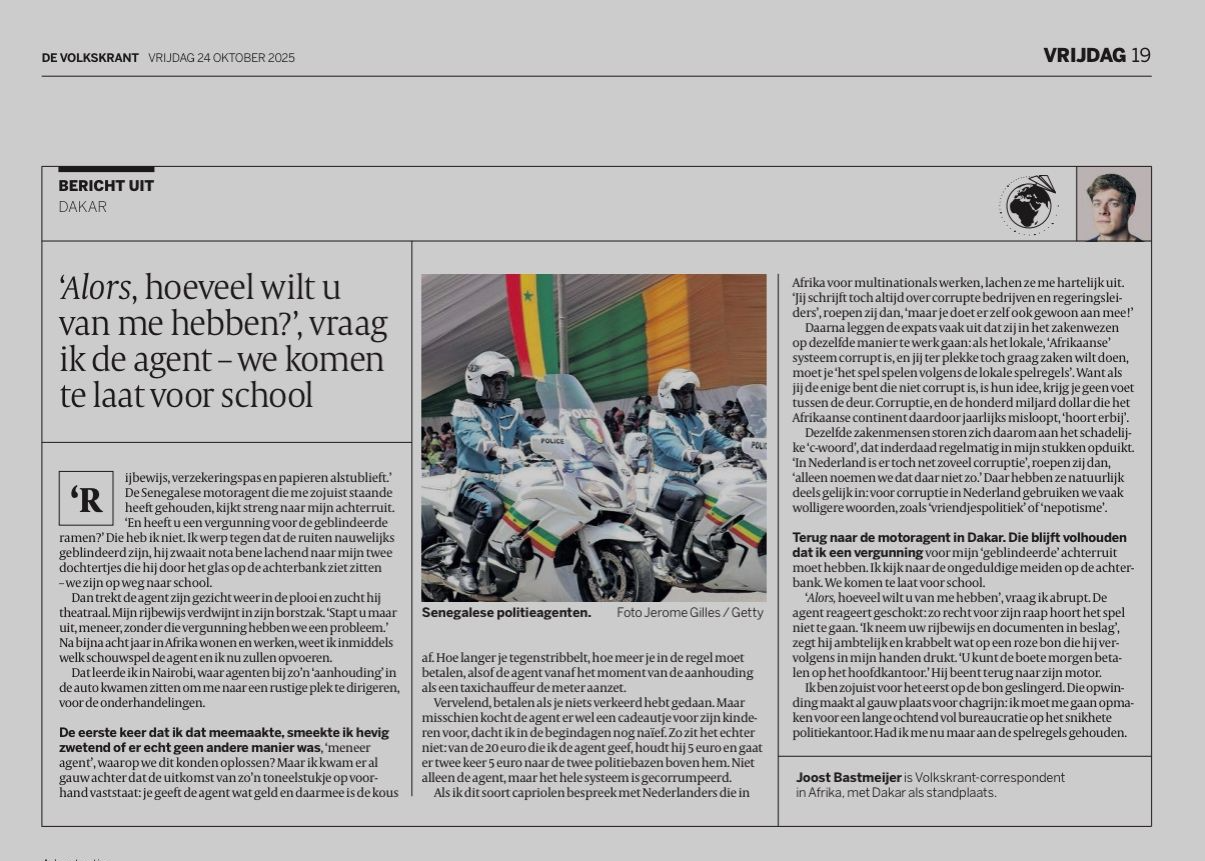
"Driver's license, insurance card, and papers, please." The Senegalese motorcycle officer who just stopped me looks sternly at my rear windows. "And do you have a permit for the tinted windows?" I don't. I object that the windows are barely tinted, and he even waves, smiling, at my two daughters, whom he sees through the glass in the backseat—we're on our way to school.
Then the officer straightens his face and sighs theatrically. My driver's license disappears into his breast pocket. "Get out of here, sir, because without that permit, we're in big trouble." After almost eight years of living and working in Africa, I now know the spectacle the officer and I are about to put on.
The first time I experienced this, I begged, sweating profusely, if there really wasn't another way, Mr. Officer, to solve this. But I soon discovered that the outcome of such a charade is predetermined: you give the officer some money and that's the end of the story. The longer you resist, the more you have to pay, as if the officer, like a taxi driver, starts the meter from the moment you stop.
When I discuss these kinds of corrupt antics with Dutch people who work for multinationals in African countries, they initially laugh heartily. "You always write about corrupt companies and government leaders," they then exclaim, "but you're just participating in them yourself!"
The expats then often explain that they operate the same way in business: if the local, "African" system is corrupt, and you still want to do business there, you have to "play by the local rules." Because if you're the only one who isn't corrupt, they think, you'll never get a foot in the door.
These same businesspeople are therefore bothered by the damaging "c-word," which indeed regularly appears in my articles. "There's just as much corruption in the Netherlands," they then exclaim, "we just don't call it that there." Of course, they're partly right: in the Netherlands, we often use friendlier, more vague terms for corruption, like "cronyism" or "nepotism."
Back to the motorcycle cop in Dakar. He keeps giving me a hard time about my rear windows. "So, how much do you want from me?" I ask abruptly. The officer reacts with shock: things shouldn't be that straightforward. "I'm confiscating your driver's license and documents," he says officially, scribbling something on a pink slip, which he then hands me. "You can pay the fine tomorrow at the head office." He strides back to his motorcycle.
I'm stunned. I've just been officially fined for the first time. That excitement soon gives way to grumpy mood: this means I have to prepare for a long morning of bureaucracy at the sweltering Senegalese police headquarters. If only I'd stuck to the rules.
The full column appeared in de Volkskrant.