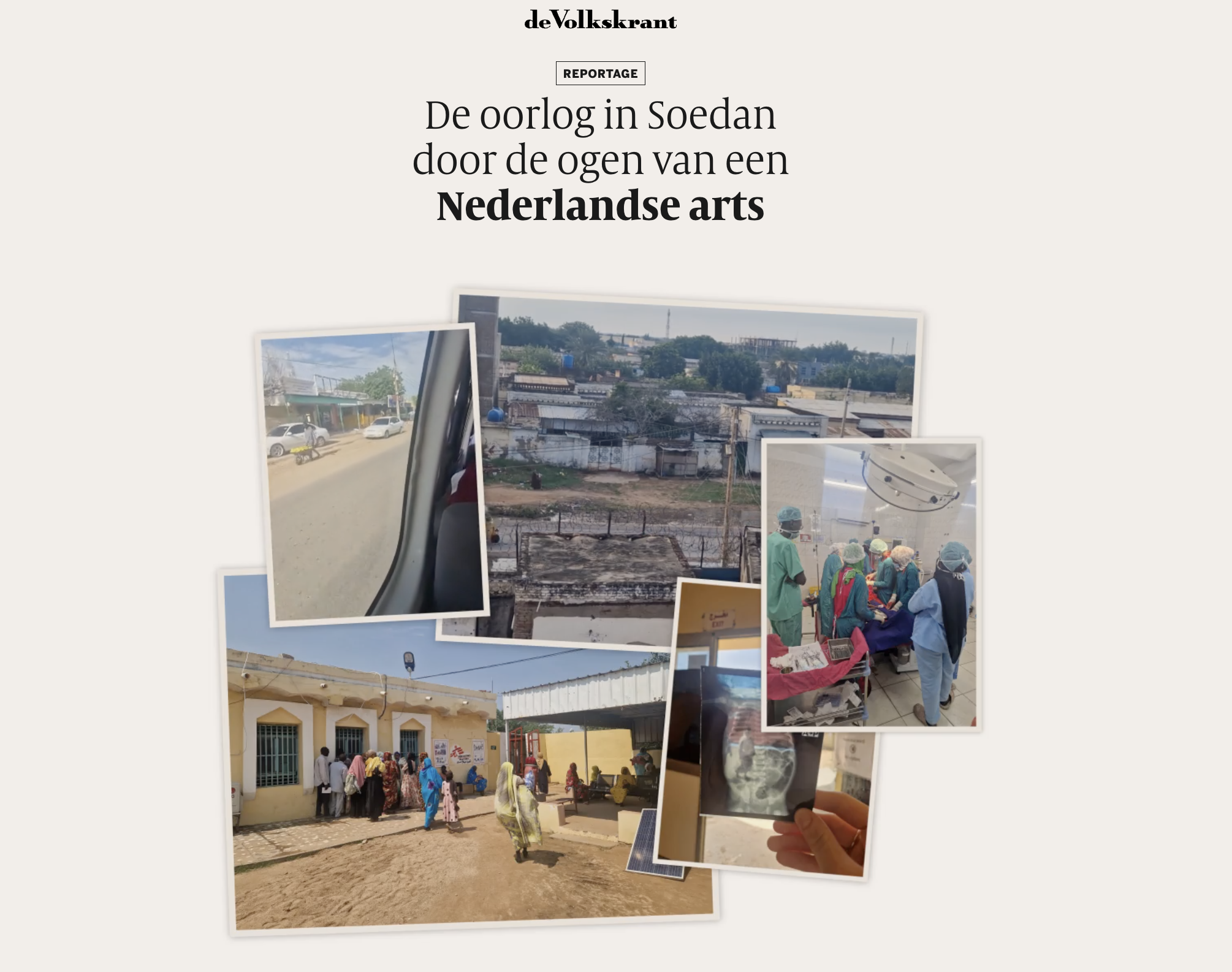
How do you report on a war you can't even touch? This question applies to Gaza, but certainly also to Darfur, where the paramilitaries of the Rapid Support Forces are believed by many to be completing the genocide they began 20 years ago. Onlookers are not welcome.
Journalists who still want to get a sense of what's happening in the Sudanese region have to rely on satellite photos and UN reports on ethnic violence (which are also often produced remotely). Contact with civilians and journalists in Darfur is very limited.
Fortunately, an exceptional opportunity recently presented itself: Dutch Doctors Without Borders doctor Fleur Smit received permission from the RSF to work as a support physician at the main hospital in South Darfur. We've been in contact via satellite for the past few weeks.
What does she see, smell, and feel in a place where the war is so close? For a week, she kept a diary for de Volkskrant. A short passage:
"The emergency room is busy, and a Sudanese doctor is under intense pressure. There are problems with the generator, resulting in little oxygen available. In the ward, a 6-year-old girl with a congenital heart defect is in critical condition. She is breathing rapidly and short and is far too thin. Her worried parents are sitting on her bed, muttering soft prayers.
"Her blood oxygen level is low, so we decide to connect her to the only available oxygen cylinder. Then, an 8-year-old boy with malaria in the bed next to her suddenly goes into cardiac arrest. While resuscitating, we face a dilemma: who should we connect to the oxygen tank?
"Fortunately, the boy's oxygen level increases; after 20 minutes of resuscitation, the boy is breathing on his own again. Before I leave, I make a plan for the night with the local doctors and nurses." After the weekend, I discovered that both children had died.
Fleur's diary is poignant and personal, and hopefully also thought-provoking: the reason doctors like Fleur lack basic medical supplies like oxygen or oral respiration is mainly due to the very limited attention (and therefore lack of aid) for what has become the world's largest humanitarian crisis.
The article appears in today's newspaper. But the online version, with timestamps, more photos, and videos, provides an even better picture of a place that normally remains invisible.
🔗 You can read the story via this link.
Many thanks to Fleur Smit, Doctors Without Borders Netherlands, Hizkia de Jong, Mirja van Baggem, Joost van Tilburg, Monique Wijnans, and Titus Knegtel.